Climate Change

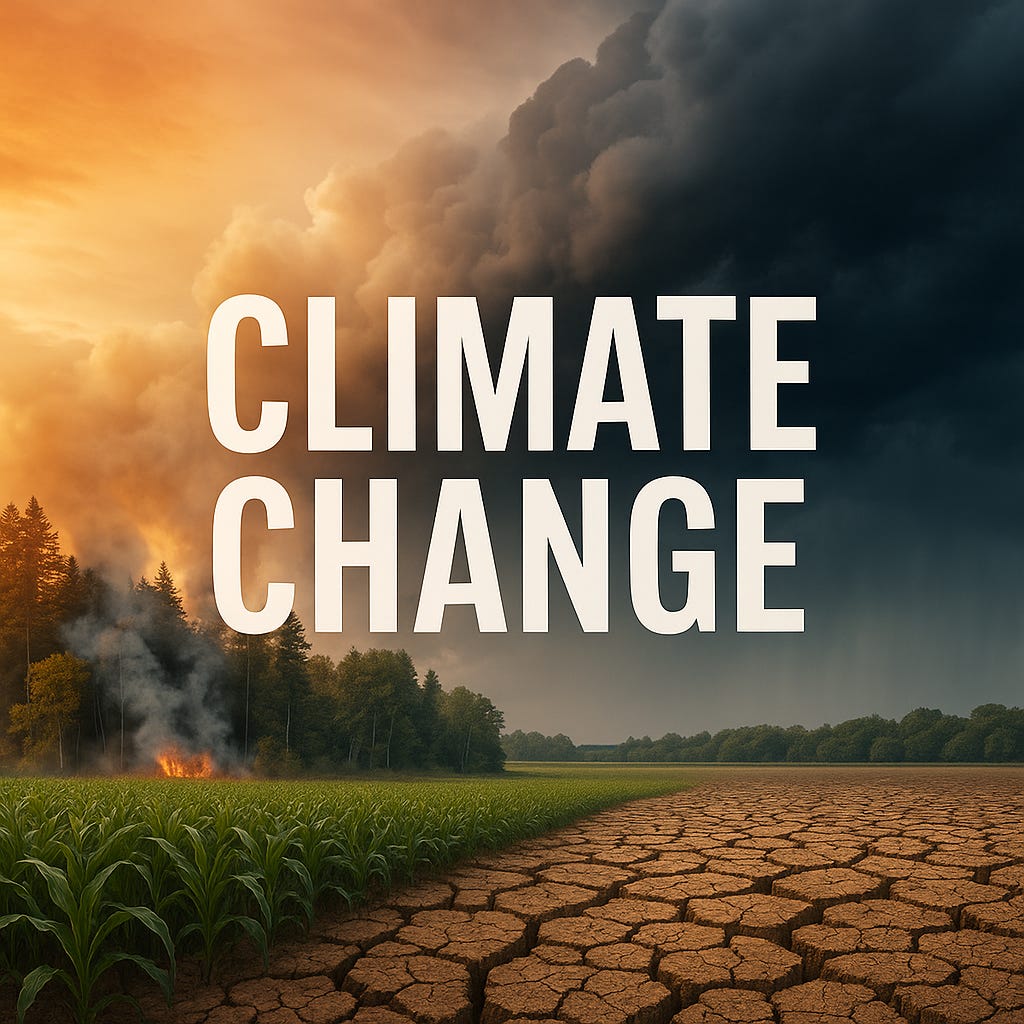
Climate change isn’t a theoretical debate anymore. It’s the backdrop of daily life: hotter summers, strange winters, smoke-filled skies, floods where they didn’t used to be, and “once-in-a-century” storms that now arrive every decade or less. The argument today isn’t really about whether the climate is changing; it’s about how fast, how bad, and what we’re willing to do about it.
What the scientists are actually saying
If you strip away the politics and listen to the people who’ve spent their lives studying this, the message is blunt.
The IPCC—the global body that regularly reviews climate science—concluded in its most recent synthesis report that warming of the climate system is “unequivocal” and that human activities, especially burning fossil fuels, are “unequivocally” the main driver.
We’ve already warmed the planet by about 1.1–1.3°C above pre-industrial levels, and the consequences are showing up in exactly the ways the models predicted: more intense heat waves and heavy downpours, stronger and wetter storms in many basins, longer and deeper droughts in others, and a clear rise in some kinds of compound extremes (for example, heat plus drought driving wildfires).
Global sea level has already risen about 8–9 inches since 1880; that rise is accelerating as glaciers and ice sheets melt. The IPCC’s work on the difference between 1.5°C and 2°C of warming shows that each additional fraction of a degree sharply increases risks: more lethal heat, more crop failures, more coastal flooding, more damage to coral reefs and ecosystems we depend on.
In short, the mainstream scientific view isn’t ambiguous: climate change is real, we’re causing it, the impacts are already serious, and they will get dramatically worse if emissions don’t fall quickly.
What Trump says about climate change
Donald Trump has for years positioned himself as a skeptic of both climate science and climate policy. He has repeatedly dismissed climate change as a “con job,” sometimes calling it “the greatest con job ever perpetrated in the world,” and has argued that predictions from climate scientists are exaggerated or “made by stupid people.”
In his 2025 address to the United Nations General Assembly, he again blasted what he called the “global climate change agenda” as a scam and warned countries that if they didn’t “get away from this green scam,” their economies would fail.
His administration’s policy moves reflect that stance:
Withdrawal from the Paris Agreement in his earlier term, arguing it was unfair to the U.S.
Systematic rollback of climate and environmental regulations, including power-plant rules and methane standards.
Most recently, a repeal and weakening of Biden-era fuel efficiency and tailpipe standards, lowering future mileage targets and relaxing penalties on automakers, framed as a way to cut costs and favor gasoline vehicles over a rapid shift to EVs.
Symbolic moves that signal a downplaying of clean energy, such as removing “renewable” from the name of the National Renewable Energy Laboratory, part of a broader tilt back toward fossil fuels.
Where the scientific community overwhelmingly sees an urgent need to reduce emissions, Trump portrays major climate policies and the energy transition as economically harmful and rooted in questionable science.
How important is climate change to the public?
Public opinion is more nuanced than the loudest voices suggest.
Globally, a massive UN survey covering countries representing 87% of the world’s population found that a majority—56%—think about climate change at least weekly or daily.
In the U.S., a large majority of Americans—around 70% or more—believe global warming is happening. Yale’s 2024–2025 climate opinion mapping estimates show roughly that figure nationally, even though belief varies from county to county. Yale Climate Communication Gallup finds record-high numbers of Americans saying global warming is a serious threat and that the effects have already begun—about 63% say they’re seeing those effects now.
But there’s a deep partisan divide over what to do:
Pew Research in late 2024 reports that a majority of Republicans say climate policies usually hurt the economy, while a majority of Democrats say they usually help.
A University of Chicago/EPIC poll finds roughly half of Americans list cutting emissions and expanding clean energy as important priorities for the next president, but the enthusiasm is heavily concentrated among Democrats. Republicans place higher priority on expanding fossil fuel production.
So climate change ranks as important to most people, but not always urgent—and its political salience depends heavily on party identity. For Trump’s core supporters, the issue often registers as secondary or even suspect; for many younger voters and those on the center-left, it’s existential.
What’s actually at stake
The potential consequences if we continue on a high-emissions path are sobering, and they’re spelled out in excruciating detail in the IPCC’s AR6 reports.
If emissions remain high and warming pushes toward 2–3°C or more this century, the world faces:
Far more frequent and intense heat waves, some reaching levels that are dangerous even for healthy adults outdoors.
More severe rainfall extremes, floods, and river overflows in many regions, alongside deepening droughts in others—stressing both water supply and food production.
Continued sea-level rise, not just inches but potentially feet over coming centuries, committing low-lying cities and entire coastal regions to either massive adaptation or retreat.
Growing risks of climate-driven migration and conflict, as droughts, storms, and heat disrupt economies and push people off the land.
Irreversible damage to ecosystems: coral reefs collapsing under heat and acidification, Arctic sea ice loss, forest dieback in some regions, species extinctions.
We should be honest: the world has already locked in some level of damage. Even if emissions dropped sharply tomorrow, seas would keep rising for a long time, and some glaciers and ecosystems cannot be “un-melted” or “un-killed.” The question now is how much additional damage we choose to unleash.
What can still be done
The science is grim, but it’s not nihilistic. The same IPCC reports that lay out the risks also emphasize that there is still a window—narrow, but real—to limit warming and avoid the worst-case outcomes.
Broadly, the remedies fall into a few buckets:
1. Cutting emissions quickly (mitigation).
This is the heart of the matter. It means:
Phasing down coal, oil, and gas and scaling up renewables, nuclear, and other low-carbon sources.
Electrifying transport—cars, buses, trucks, in some cases trains and short-haul aviation—and powering them with cleaner grids.
Improving efficiency everywhere: buildings, industry, appliances, vehicles.
Addressing non-CO₂ gases like methane from fossil fuels, agriculture, and waste, because they warm the planet strongly but briefly; cutting them can slow near-term warming.
2. Adapting to the changes we can’t avoid.
Even in best-case scenarios, we’ll need:
Stronger flood defenses and smarter land-use planning in floodplains and coasts.
Heat-resilient infrastructure and urban planning: shade, cooling centers, updated building codes.
Climate-resilient agriculture, including crop varieties and practices that can handle heat, drought, or excess water.
Health systems prepared for heat waves, vector-borne diseases, and climate-related disasters.
3. Removing some CO₂ from the atmosphere.
Most pathways that limit warming below 2°C assume some level of carbon dioxide removal, whether through nature-based methods (reforestation, restoring wetlands and soils) or technological ones (direct air capture, bioenergy with carbon capture). These aren’t magic wands—they’re supplements, not substitutes, for cutting emissions—but they matter in the long run.
Is it too late?
This is the moral core of any honest editorial on climate change: not “Is it real?” but “Is there still something meaningful we can do?”
From a scientific and policy standpoint, two things are true at the same time:
It is too late to avoid climate change.
We’ve already altered the climate. Some impacts are locked in for centuries: higher seas, altered weather patterns, and the loss of certain ecosystems.It is not too late to influence how bad it gets.
Every fraction of a degree matters. The difference between 1.5°C and 2°C, between 2°C and 3°C, is measured in lives, livelihoods, and square miles of land lost to the sea. The IPCC is explicit: deep, rapid, sustained emission cuts this decade can still keep the most catastrophic scenarios off the table and make adaptation more manageable.
Scientists by and large reject fatalism. When climate researchers respond to rhetoric like Trump’s “greatest con job ever,” they point back to decades of accumulating evidence and the visible changes unfolding around us. They also stress that our choices now—policies passed, technologies deployed, habits changed—determine whether today’s children inherit a world that is difficult but manageable, or one that is chaotic and harsher in almost every respect.
Where that leaves us
So where does that leave an ordinary reader, somewhere between apathy and panic, watching political leaders either sound the alarm or wave it away?
It leaves us in a place that’s challenging but not hopeless. The climate system doesn’t care about speeches, but it does respond to physics: the amount of greenhouse gas in the atmosphere, the pace at which we add more, the land and energy systems we build. Leaders can deny the science, mock renewable energy, or roll back standards. None of that changes the underlying reality; it only changes how prepared we are for what’s coming and how many people are left exposed.
The sober takeaway from reputable climate science is this: it is late, but not too late for better to be meaningfully better than worse. The planet we get in 2050 or 2100 is not predetermined; it’s being negotiated right now in parliaments and boardrooms, in city councils and utility commissions, in personal choices about cars, homes, and votes.
We can’t choose between “fix everything” and “give up.” Those were never the real options. The real choice is between degrees of disruption: between a future that is harsh but livable, and one that is far more brutal and unfair than it needs to be.
( I use an ever increasing number of references to get the details I need to write my editorials. Substack has advised me that my list of references are too long to include in emails. As such, I will no longer include them. However, you can contact me to request the list for any of my editorials and I will send them to you. )